
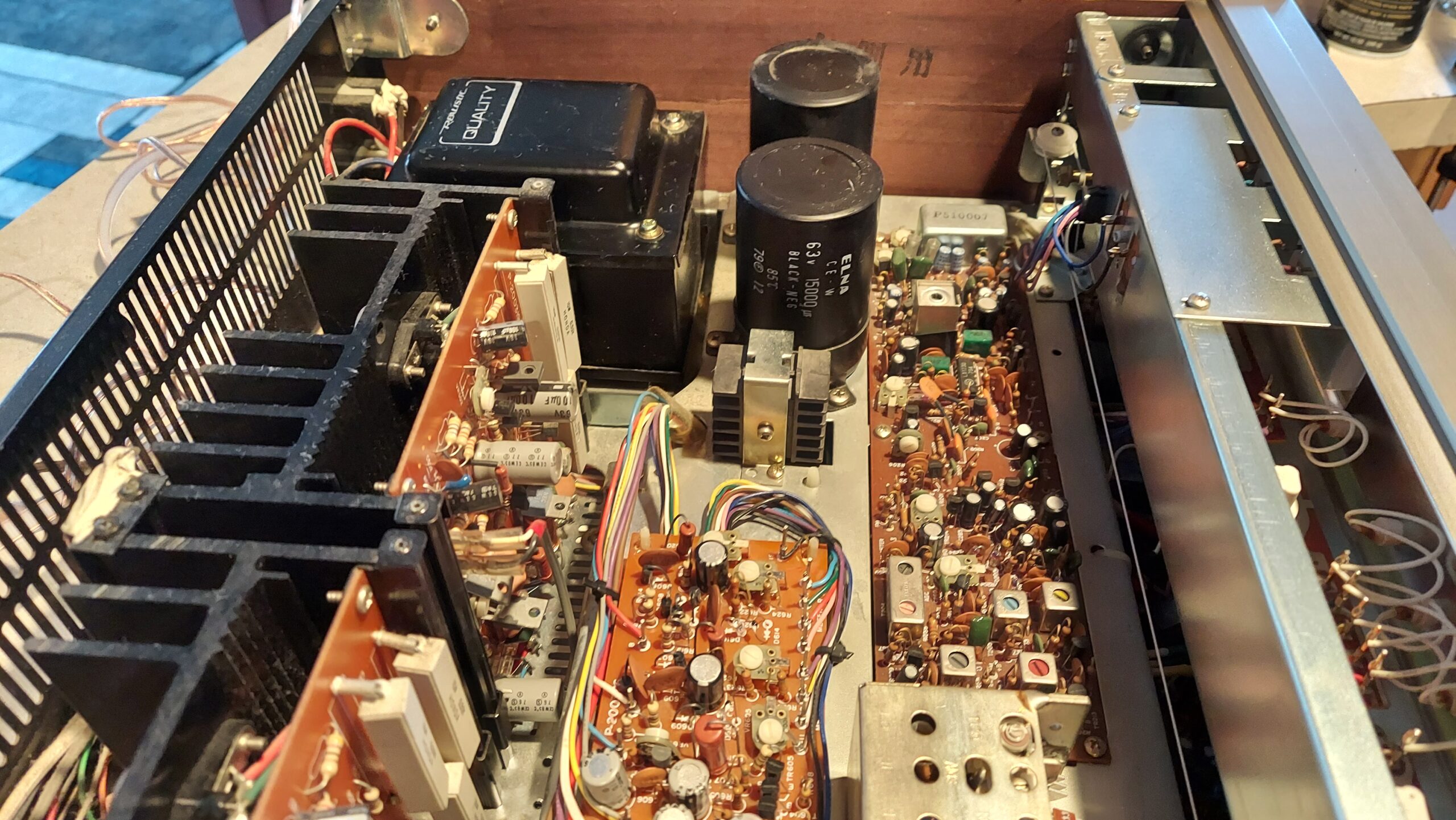
Board-Swapping Is a Shortcut That Costs You Twice
Most repair shops work at the board level. Your amplifier has multiple circuit boards: power, preamp, and output. If it doesn’t work, they start swapping boards until it does, and then they bill you for the board. It’s fast for them, and it’s profitable for them. It just isn’t repair.
Here’s the part they don’t tell you. Ninety-five percent of the time, only one component on that board failed: a capacitor, a resistor, or a diode. One part. The whole board gets tossed anyway.
You pay for a new board, and they make more money. Meanwhile, your amp leaves with a board that’s going to fail the exact same way in a few years, because nobody ever asked why the first one died.
And that original fifty-year-old board? It’s gone. Not repaired. Thrown away.
What I Do Instead: Find the One Part That’s Actually Dead
Component-level repair means answering the real question: Why doesn’t this amplifier power on? Is it the power supply, the main fuse, a tripped protection circuit, or one dried-out capacitor?
You measure. You test. You trace the circuit and follow the signal until you find exactly where it’s getting stuck. Then, and only then, you fix the one component that’s actually broken.
It’s slower, a lot slower. You’re running real diagnostics instead of swapping parts and hoping. But when it’s done, the amp works, and it works because the actual problem got fixed, not because you got lucky with a $200 board.
Your 50-Year-Old Amp Can’t Survive Many More “Fixes” Like That
Vintage amplifiers and receivers are 40 to 50 years old, and their boards are fragile. Every time a board gets pulled and reinstalled, it stresses the solder joints and traces a little more. That’s why “repaired” vintage gear so often works for a month and then dies again.
Swap the board instead of fixing the actual component, and the original problem is still sitting there. You’ve just bought a new board that’s aging toward the same failure.
Component-level repair respects the equipment. You diagnose carefully, fix the specific problem, and preserve the original board. That’s what makes it last.
Inside a Real Diagnosis
Here’s what component-level diagnostics actually looks like.
Power on. No sound. Hum from the speaker. That tells me the preamp and power amp stages are probably working, but there’s something in the power supply causing the hum.
Measure the output voltage on the power supply. Is it stable? Is it the right voltage? Or is it fluctuating? Fluctuating voltage usually means a failing capacitor.
Test each capacitor in the power supply. Are they in spec? Or are they reading out of range? Find the bad one.
Check the circuit. Is that bad capacitor the root cause, or is it a symptom? Is there a load on that power supply that shouldn’t be there? Is there a resistor that’s burned out? Is there a diode that’s shorted?
Once you understand the full picture, you fix the one thing that actually needs fixing. Not replace the whole board. Fix the component.
You Can’t Fake This With a YouTube Video
Real diagnosis takes real equipment: a multimeter, an oscilloscope, a signal generator, and a component tester. You need to measure, see waveforms, and know what normal looks like well enough to spot what isn’t.
You need to understand circuit theory: how preamps work, how power supplies work, and how protection circuits work. You need to read a schematic and trace signal flow like it’s second nature.
You also need the right parts on hand: capacitors, resistors, diodes, transistors, and transformers, along with the knowledge of which original or equivalent parts actually belong in that design. Most of all, you need time, real diagnostic time, not a guess-and-swap.
Why Most Shops Won’t Do This
Component-level repair is profitable if you price it right, but it’s slow. A shop doing board swaps can churn through five amplifiers a day. A tech doing component-level work might finish one.
Five board-replacement jobs beat one component-level job on revenue, so most shops optimize for speed instead of actually fixing your equipment. That’s a business decision. It just isn’t repair.
What You Actually Get Back
You get equipment that’s diagnosed, not patched over, with the root cause found and fixed instead of buried under a new part.
That’s the approach I’ve used for 50+ years. It’s why customers come back, and why the equipment I’ve worked on is still running years later.
Component-level repair takes longer, and it can cost more up front. But it’s the repair that actually holds.
Frequently Asked Questions
What is component-level repair?
Component-level repair means diagnosing equipment down to the exact failing part, like a specific capacitor, resistor, or diode, and replacing only that part instead of swapping the whole circuit board.
Why do repair shops replace whole boards instead of individual parts?
Board-level replacement is faster and more profitable, since it skips real diagnostic work. But most of the time, only one component on that board actually failed, so the shop charges more without fixing the root cause.
Why does a “fixed” vintage amplifier break again?
If a shop replaces a whole board instead of finding the specific failed component, the root cause never gets addressed. The new board ages the same way the old one did, and the same failure happens again.
What tools does component-level repair require?
A multimeter, oscilloscope, signal generator, and component tester, plus the circuit theory knowledge to read a schematic and trace signal flow to the exact point of failure.
Got vintage equipment that needs real repair? Contact us for component-level diagnostics. We’ll find out what’s actually wrong and fix only what needs fixing.