
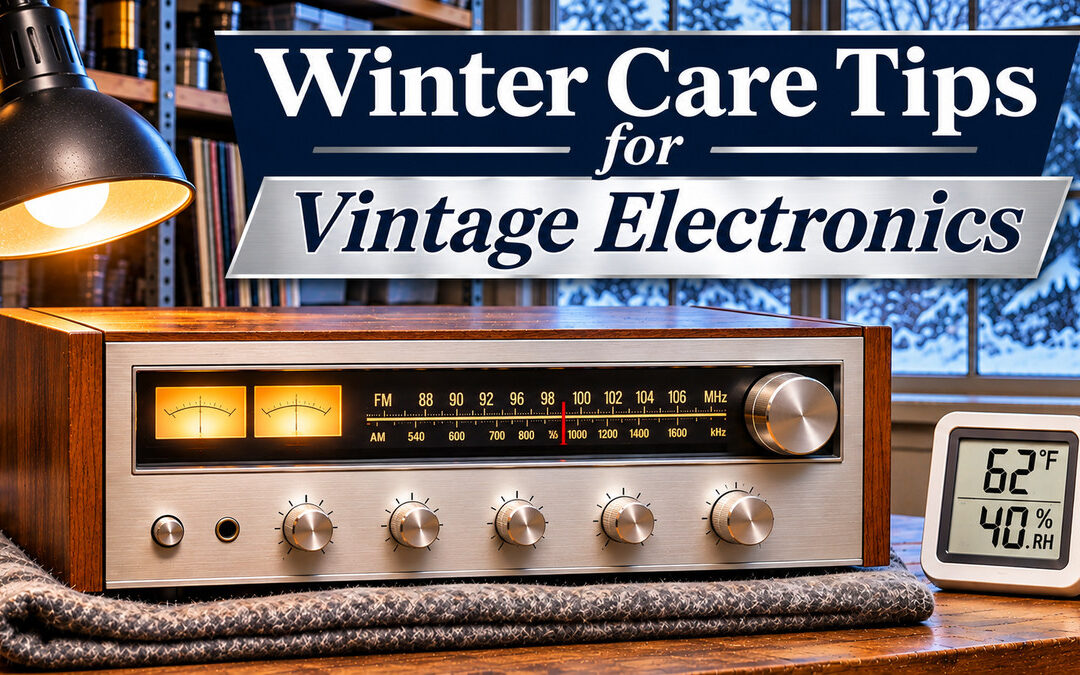
Summer isn’t the only season that’s hard on vintage electronics. Winter care for vintage electronics matters too, just for different reasons. Dry indoor heat. Cold garages and cars. Static electricity. If you own vintage audio equipment, winter deserves the same attention you’d give it in July.
I’ve been doing this for 50+ years, and every winter I see the same thing: someone brings in a receiver or turntable that sat too close to a heat vent, or got hauled in from a freezing garage and plugged in right away. The damage is preventable. Most people just don’t know what to watch for.
Here’s what winter actually does to vintage electronics, and how to keep your equipment safe until spring.
Dry Heat Is the Winter Version of Summer’s Humidity
In summer, humidity is the problem. In winter, it flips. Furnaces and space heaters pull moisture out of the air, and that dry air isn’t kind to old equipment either.
Rubber components, belts, and gaskets can dry out and crack faster in low humidity. Wood veneer cabinets can shrink slightly and develop hairline cracks. It’s slower and less dramatic than heat damage, but it adds up over a winter spent parked next to a vent.
Keep vintage equipment away from heating vents, radiators, and space heaters. A few feet of distance makes a real difference. If you can, a small humidifier in the room helps both your equipment and your furniture.
Temperature Swings Are the Real Danger
This is the big one. Bringing equipment in from a cold car or an unheated garage and plugging it in right away is one of the fastest ways to cause condensation damage.
When something cold comes into a warm room, moisture in the air condenses on it, the same way your glasses fog up when you walk inside. That condensation forms on and inside your equipment too, on circuit boards, connectors, everything. Power it on while it’s still damp inside and you’re risking a short.
If you just picked up a vintage receiver at an estate sale in December, or you’re moving equipment out of a cold garage or storage unit, let it sit at room temperature for a few hours before you plug it in. If it was really cold, let it warm up slowly and dry out on its own.
Static Electricity Builds Up in Winter
Dry winter air means more static. You’ve felt it yourself, touching a doorknob or another person and getting a shock. That same static can damage sensitive components inside vintage electronics if it discharges into the wrong spot.
Before you handle the inside of any equipment, or even touch input and output jacks, ground yourself first. Touch something metal and grounded, like an unpainted metal appliance, before you touch the equipment. If your home is particularly dry and static-prone, a humidifier helps here too.
Cold Storage Isn’t Automatically Safe
An unheated garage or storage unit might seem fine for vintage equipment over the winter since it’s dry, not damp like a summer basement. But repeated freeze-thaw cycles as the temperature swings day to night still stress solder joints and components over time.
If you have a choice, store vintage equipment somewhere that stays at a stable temperature, ideally inside your house. If it has to be in a garage or unheated space, try to keep it somewhere the temperature doesn’t swing as wildly, away from garage doors and outside walls.
What Happens If You Don’t Do This
Sometimes nothing happens. Other times I’ll open a unit up and find corrosion starting on a board that looked fine from the outside, or a short that doesn’t show up for weeks, just an intermittent crackle or dropout that gets worse over time. By the time you notice it, the damage is already done.
It’s avoidable almost every time, and waiting a few hours doesn’t cost you anything.
Winter Care Is Simple Once You Know the Risks
Keep it away from heat sources, let it warm up gradually after being in the cold, and watch out for static when you’re handling it. That’s most of it.
Your vintage equipment can handle a cold winter fine as long as you’re not rushing it from one extreme to another.
One more thing: we shut down for the holidays each year, December 23rd through the 25th, and again from the 30th through January 4th. If you want to get on the list before the new year, get it in before those dates.
Noticed an issue with your vintage equipment this winter? Get in touch, and we’ll figure out what’s going on.