
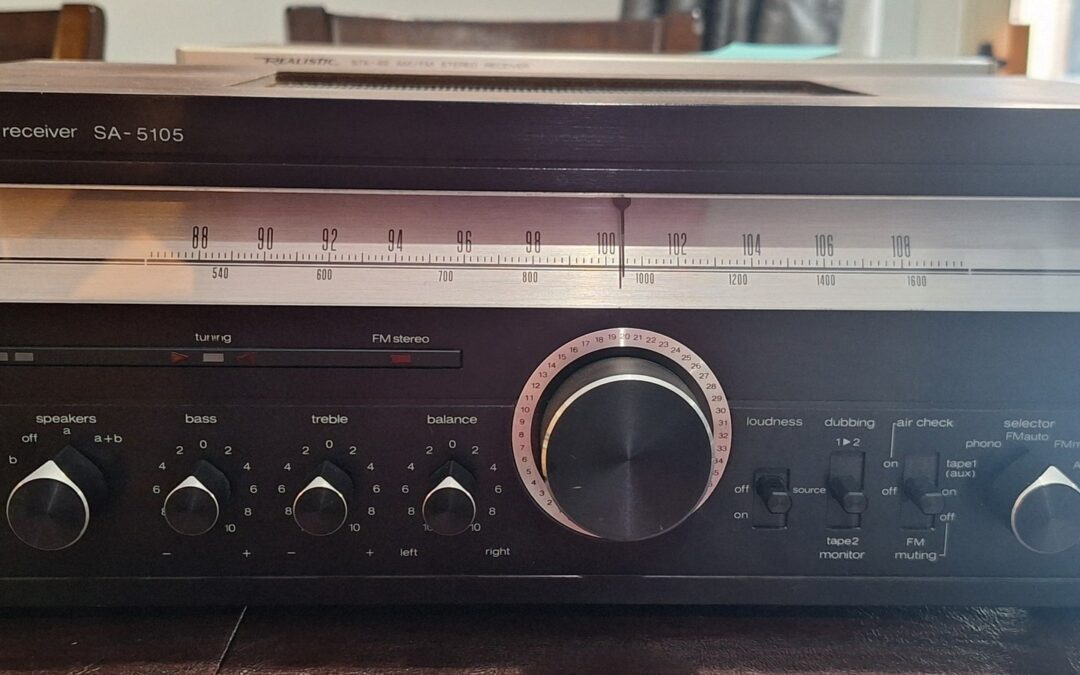
I’ve been fixing vintage audio equipment for 45+ years. And I’ve watched something shift over that time: people who buy vintage audio aren’t buying it for nostalgia. They’re buying it because it’s genuinely better than what’s being made today.
The vintage vs. new comparison isn’t even close. And I’m not being romantic about it. I can measure it. I can hear it. I can explain exactly why vintage audio wins.
Here’s the real story behind vintage audio vs. new equipment, and why your 1975 receiver is a better investment than a modern alternative.
Design Philosophy Changed
In the 1970s and 1980s, audio engineers designed for sound quality. That was the goal. Build equipment that sounds good. Make it reliable. Make it last.
Cost mattered, but it was secondary. Engineers would design a power supply with a massive transformer and multiple capacitors because that gave you better, cleaner power. They’d use high-quality resistors even if cheaper ones existed. They’d run frequency response tests to make sure the output was accurate.
Today, manufacturers design for cost. How cheap can we make this? How can we get it to market fast? How many units can we sell at what price point? Sound quality is secondary. Longevity doesn’t matter because you’re expected to throw it away in five years anyway.
Vintage audio was engineered differently. The priorities were inverted.
Build Quality and Materials
Open up a vintage receiver from the 1970s and look at the components. Huge capacitors. Robust power transformers. Heavy-gauge wiring. Gold-plated connectors. Everything is overbuilt.
Modern equipment uses the minimum viable components. Tiny capacitors. Cheap transformers. Thin wiring. Plastic connectors. They’re designed to last just long enough to get out of warranty.
Vintage equipment was built when longevity was expected. These were investments. People bought a receiver and expected to use it for 20 or 30 years. So it was built to survive 20 or 30 years.
That quality is still there. A vintage receiver from 1975 that’s been properly maintained still sounds as good as it did when it was new. A modern receiver bought new today will probably fail within five years.
Sound Quality Is Measurable
This isn’t opinion. You can measure it.
Frequency response: Vintage audio equipment has flatter, more accurate response across the audible spectrum. Modern equipment tries to “enhance” sound with presence peaks or bass boosts. Vintage equipment was designed to be true to the source.
Signal-to-noise ratio: Vintage audio equipment has lower noise floors. The background hum and hiss you hear is lower. That matters when you’re listening to quiet passages.
Distortion: Vintage audio equipment has lower total harmonic distortion. That means cleaner, more transparent sound. Modern equipment often has higher distortion as a result of cheap components and minimal power supplies.
These are measurable differences. Not marketing claims. Real technical specifications.
Why Vintage Audio Sounds “Warmer”
People say vintage audio sounds warmer than new equipment. That’s real. Here’s why.
Vintage amplifiers and receivers used output transformers. Those transformers had a subtle harmonic quality to the sound. They added a presence that modern solid-state equipment doesn’t have. It’s not a flaw. It’s a characteristic.
Modern equipment tries to be “perfectly neutral.” That means removing everything that could be seen as coloration. But that perfect neutrality sounds cold and clinical. It’s the opposite of engaging.
Vintage audio engineers understood that some warmth, some harmonic character, made equipment sound more musical. They designed for that. They knew what sounded good.
The Investment Angle
Here’s something people don’t always realize: vintage audio equipment is an investment that appreciates.
A rare vintage receiver from the 1970s that cost two hundred dollars new might sell for five hundred today. A highly sought model could be worth a thousand. The equipment ages. It becomes more valuable.
A modern receiver that costs two thousand dollars today will be worthless in 10 years. It will be obsolete. The technology will be dated. The components will be failing. You can’t give it away.
Vintage audio equipment you buy today and maintain properly could be worth more in five years than you paid for it. That’s an investment. New equipment is a purchase you throw away.
Serviceability
Most vintage audio equipment can be repaired, provided the parts are available. Sometimes that means an exact replacement. Sometimes it means pulling a part off a donor unit. Not every piece can be saved, and I won’t pretend otherwise. But the parts situation is usually the limiting factor, not the design itself.
The bigger issue is that a lot of this work needs to happen at the component level, and there aren’t many people left who actually do that. Circuit designs are documented, and an experienced technician can work on a vintage receiver from almost any era because the fundamentals hold up. But that only matters if someone still knows how to get in there and diagnose the real problem instead of just swapping parts until something works.
Modern equipment is often unrepairable. Proprietary chips. Soldered components you can’t replace. No documentation available. When something breaks, you throw it away and buy new.
Vintage equipment lasts because it can be repaired, when someone still knows how. Modern equipment doesn’t last because it usually can’t be, no matter who you ask.
Vintage Audio Isn’t Perfect
I’m not saying vintage equipment is infallible. Capacitors age. Some designs had flaws. Certain manufacturers built better equipment than others.
But a well-maintained vintage amplifier or receiver will outperform a modern equivalent in sound quality, reliability, and longevity. That’s just factual.
The Verdict
Vintage audio wins on sound quality. Wins on build quality. Wins on reliability. Wins on repairability. Wins on investment value.
The only thing modern equipment wins on is cost up front. But you pay for that with poor sound quality, poor reliability, and no long-term value.
That’s why I believe in vintage audio. It was built better. It was designed for sound quality. It still performs. And it will keep performing if you take care of it.
Want to start building a vintage audio collection? Browse our serviced equipment to find properly maintained vintage gear ready to use.