
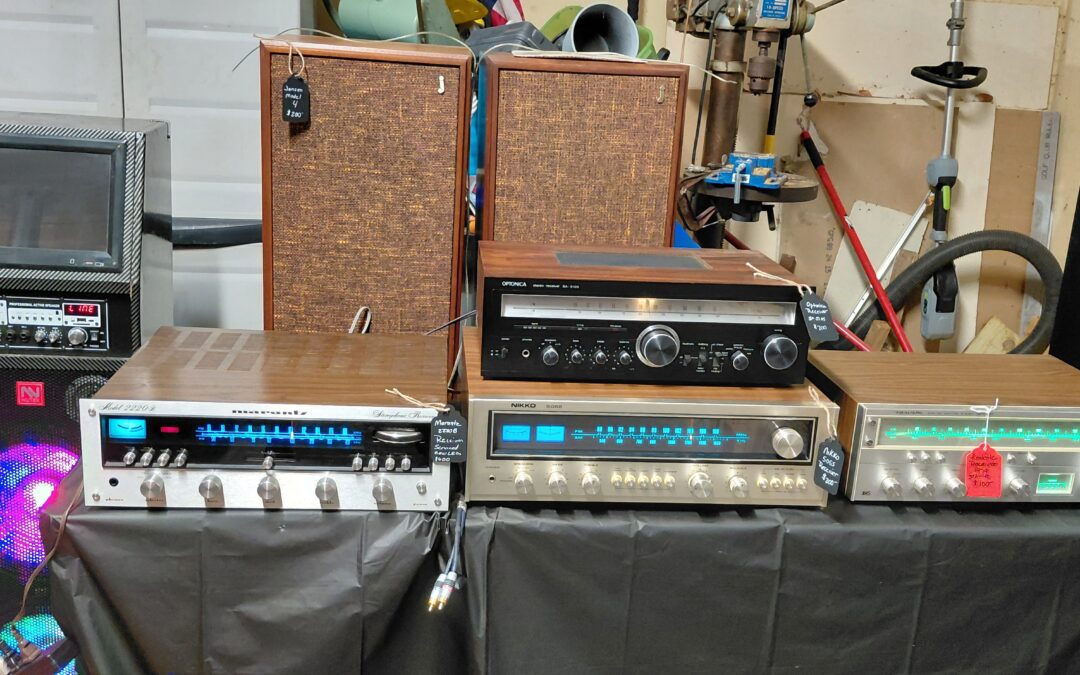
It’s Saturday morning at an estate sale.
You find a vintage receiver that looks perfect.
But you have five minutes to decide. Buy it or pass?
You can’t plug it in. Can’t run tests. You just have to look, listen, and trust your gut.
After 50+ years evaluating vintage audio, I know what a piece tells you in 30 seconds. Here’s how to spot a real find and skip the money pits.
The Smell Test
Smell it first.
No smell? A little electronics smell? Good. That’s normal.
Burnt smell? Hot. Metallic. Chemical. Walk away. Something failed internally. The repair will be expensive.
Musty smell? Damp? Mildew? Pet odors? That’s moisture damage. Corrosion inside. Rust on parts. These repairs are nasty and pricey. Pass.
Your nose tells you more in 10 seconds than your eyes tell you in five minutes.
The Visual Check
Check the knobs. Missing knobs mean rough handling.
But before you buy, check if replacement knobs are available. How expensive are they? How hard are they to find? Some of these are really hard to track down.
Cracked faceplate? Minor scratches are fine. Major cracks mean rough storage.
Check the back panel. Look at speaker terminals and RCA jacks. White or green stuff? That’s corrosion. Moisture got inside. Usually fixable, but it’s work.
Any visible rust? Severe moisture exposure. Probably rust inside too. Skip it.
The Weight Test
Pick it up.
Heavy and solid? Good transformer and quality parts inside.
Light and cheap-feeling? The internals probably are too. Thin transformers. Minimal parts. Lower-tier equipment.
The Cable Test
Look at the power cord.
Frayed? Cracked? Damaged? Fire hazard. Replace it before powering on.
Check the RCA jacks. Can you move them without the whole assembly wiggling? Loose jacks mean internal problems. Fixable. But know what you’re getting into.
The Power-On Test
Ask if you can plug it in. Don’t touch it once it’s on. Just watch.
Powers on cleanly? Light comes on. Dial glows. No pops or clicks? Excellent sign. Power supply works.
Nothing happens? It pops when plugged in? Capacitor failure or short circuit. Don’t try again.
Worst: it smells burnt while powered on, or you see smoke. Sometimes this is just the power switch arcing, usually a cheap fix. But it could be something serious burning inside. Hard to diagnose on the spot. But if something major is burning, skip it.
The Sound Test
If it powers on and has speakers, ask to test the audio.
Clear sound? No crackling or humming? Buy it.
Crackling when you wiggle cables? Dirty jacks or loose connections. Fixable. Extra work.
Heavy hum or buzz all the time? Power supply problems. More expensive fix.
No sound at all? Too many unknowns. Skip it.
The Brand and Model Check
Google the brand right there.
Marantz? Yamaha? Pioneer? Technics? Harman Kardon? McIntosh? These are solid. Built to last. Parts are available. Worth fixing.
Lower-tier brands? Do a search. Check reviews. See if people say it’s reliable.
The Transport Test
Can you get it home?
Too heavy? Too fragile? Knobs going to break in your car?
Think it through before you commit.
Trust Your Gut
If something feels off, it probably is.
You don’t have time for a full diagnostic. You go on instinct and do the quick checks you can do in five minutes.
Smells good. Feels solid. Powers on clean. Sounds clear? That’s a buy. Even if it needs some work, you’re starting from a good place.
Corrosion. Burnt smell. No power? That’s a pass.
Found something and not sure? Check our repair FAQ. Get answers and request an evaluation right there.
Want more tips like these? Subscribe to our newsletter for estate sale strategies, buying guides, and repair insights.