
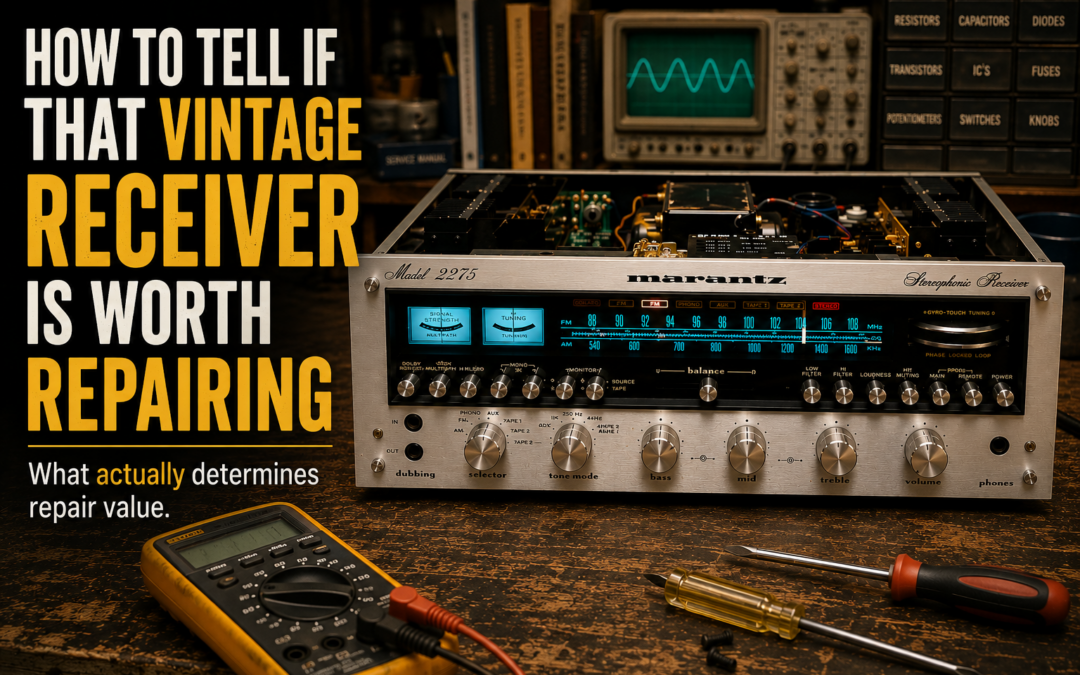
Whether a vintage receiver is worth repairing depends on five things. Most people only think about one of them, and it’s usually not the most important one.
You found it at an estate sale. The case is pristine, and you’re convinced it just needs a little work. Then you plug it in, and nothing happens. Or it powers on, but there’s no sound, the knobs are stiff, something smells faintly hot. I hear this every week. Someone walks in with a vintage receiver, torn between what they love about it and what they don’t know about what fixing it will actually cost. The honest answer: sometimes yes, sometimes no. And the deciding factor isn’t what you think.
The Real Question Isn’t “Can It Be Fixed?”
It’s “Should it be?”
Almost anything can be repaired if you throw enough money at it. Old capacitors can be replaced, transformers can be rewound, and corroded circuit boards can be cleaned. But just because something can be fixed doesn’t mean it should be. I’ve been doing this for 45+ years, and the best repairs are the ones that make financial and practical sense.
Here’s How I Evaluate It
When someone brings in a receiver, I ask myself five questions:
1. What’s the actual problem?
There’s a big difference between a unit that won’t power on and one that powers on but sounds terrible. A bad capacitor? Fixable, maybe $50–200 in parts. A transformer that’s shorted out? That’s a different conversation. Parts alone could run $300–600, plus labor.
I need to diagnose it first. That’s why we charge a diagnostic fee. It’s not to nickel-and-dime you. It’s to give you real information before you make a decision.
2. What year/model is it?
A 1970s Marantz or Sansui? Those are built like tanks, and parts are often available. A 1990s budget model from a brand that went out of business 20 years ago? That’s a problem. If the power supply fails and the exact replacement transformer isn’t available, you’re looking at custom rewinding or expensive workarounds.
3. Is this a popular model?
Certain receivers are legendary. They hold their value. A Marantz 2270 or a Sansui 8080 is worth fixing because people want them, parts exist, and they sound incredible. A random no-name brand receiver? If it costs $400 to repair, and you can buy a working used version for $250, the math is simple.
4. What’s your emotional attachment?
I’m not being sarcastic. This matters. If your grandfather owned this receiver and you want to restore it, that’s a valid reason to spend more than the “logical” amount. Sentimental value is real value. But I need you to go in with your eyes open about what it will cost. If you picked it up because it was cheap and you thought you’d flip it, then we need to talk about the real repair cost versus resale value.
5. Can you actually use it when it’s fixed?
This one surprises people. I’ve fixed receivers where the output is only 15 watts, which sounds like nothing to modern ears used to 100-watt systems. Some units have no remote. Some have quirky features that nobody likes. If this costs $300 to repair, ask yourself honestly: Will I actually use it? Or will it sit in my closet?
Here’s What It Typically Costs
Let me give you real numbers based on what I see every day:
Simple repairs (cleaning, loose connections, minor part replacement): $50–150
These are usually old capacitors that are losing effectiveness, or switches that need cleaning
Quick turnaround, big improvement in sound quality
Moderate repairs (capacitor replacement, tube replacement, minor board work): $150–400
You’re replacing aging components that are failing
This is the most common repair we do
Usually brings a receiver back to like-new condition
Major repairs (transformer issues, extensive board work, hard-to-find parts): $400–$1,000+
These take time and specialized knowledge
We might need to source parts from multiple suppliers
Could take 2–3 weeks if we’re waiting on a specific part
Don’t – fix – it territory ($1,000+): This is when the repair cost exceeds the realistic market value of the unit. Unless there’s serious sentimental value, it doesn’t make financial sense.
The Real Cost You’re Not Thinking About
Repair isn’t just parts and labor. Your receiver might sit on my workbench for 2–3 weeks while I wait for a specific part. There’s real expertise involved in diagnosing vintage electronics, and there’s always the risk that once I open it up, I find additional problems we didn’t anticipate.
And there’s no guarantee. If a vintage component fails after we repair it, we can only control what we did. We can’t control how that unit was stored for the last 30 years.
So Here’s My Advice
Bring it in for a diagnostic. That costs about $50–75, and it gives you real information before you make any decision.
Don’t guess. Don’t hope. Don’t assume.
You’ll know what’s broken, what it will cost to fix, how long it will take, and whether it makes sense to proceed. Then you decide. Some people will say, “Yes, fix it. It was my dad’s receiver.” Others will say, “No thanks, I can buy a working one cheaper.” Both answers are right. You just need the facts first.
The worst repair decision is the one made without information. The second-worst is deciding to fix something that doesn’t make sense financially, then being surprised when it costs more than expected.
Get the diagnosis. Look at the numbers. Then decide. That’s how you know if that beautiful vintage receiver sitting in your garage is worth fixing.
What’s sitting in your basement or garage that you’ve been wondering about? Send us a message before you bring it in. We’ll tell you straight.